We don’t know about you, but we’re still reeling from last Friday’s news about Elon Musk becoming America’s and the world’s first trillionaire. This is not the kind of news we should move past just because the news cycle says so, especially when we’ve been warning about this moment for over a decade. In fact, our Senior Vice President for Tax Policy, Bob Lord, predicted this moment thirteen years ago, but it still came faster than he or any of us at Patriotic Millionaires expected.
It’s hard to emphasize just how historic a moment this is, largely because it’s difficult to convey just how much money $1 trillion actually is—or, we should say, $1.3 trillion, as that’s how much Musk is actually worth as of this writing.
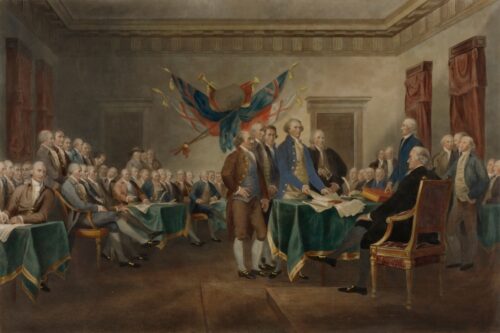
We feel it’s a bit ironic—and, frankly, eerie—that we’re witnessing the birth of our first trillionaire on the eve of America’s 250th birthday. We’ll have a lot more to say about America 250 and what the Patriotic Millionaires are doing to mark the occasion as we get closer to July 4th. But for this week’s Closer Look, we want to highlight the Founding Fathers’ complicated role in delivering America its first trillionaire 250 years after they declared independence from the British monarchy.
We’ll start by highlighting the warnings that the Founders expressed about extreme wealth concentration, then highlight the actions they took which set in motion the creation of the very “aristocracy of wealth” that they purportedly feared. We’ll do our best to end on a positive note by offering our vision for how we can heed the Founders’ (hollow) warnings and commit ourselves to reining in extreme wealth inequality once and for all.
*****
Short on time? Here’s what you need to know
- Elon Musk became the world’s first trillionaire last Friday. This historic moment comes on the eve of America’s 250th birthday.
- The Founding Fathers warned about the dangers of extreme wealth accumulation at the time of America’s birth. For example, in a letter to James Madison in 1785, Thomas Jefferson wrote, “I am conscious that an equal division of property is impracticable. But the consequences of this enormous inequality producing so much misery to the bulk of mankind, legislators cannot invent too many devices for subdividing property.”
- Unfortunately, however, the Founders’ actions spoke louder than their words on the issue of wealth inequality. Many of them were slaveowners, and also took major steps at the Constitutional Convention in 1787 to design the government in ways that protected moneyed interests.
- We believe our four-part legislative platform, The MONEY Agenda, offers a way for America to heed the Founders’ warnings, make up for their failings, and rein in excessive wealth once and for all.
******
What the Founding Fathers said about extreme wealth
Extreme wealth concentration is dangerous to our economy, democracy, and environment. But this isn’t a novel idea, because it’s something that America’s Founding Fathers warned us about centuries ago.
Below is a sample of the bold denouncements the Founders gave regarding wealth inequality and the influence of large moneyed interests over politics, along with their corresponding support for progressive taxation:
“In the first place it is a point conceded, that America, under an efficient government, will be the most favorable Country of any in the world for persons of industry and frugality, possessed of a moderate capital, to inhabit. It is also believed that it will not be less advantageous to the happiness of the lowest class of people because of the equal distribution of property the great plenty of unocupied lands, and the facility of procuring the means of subsistance.”—George Washington, the United States’ first president, wrote these words in a letter to Richard Henderson in 1788. Like the Patriotic Millionaires, Washington understood that wealth more broadly distributed was the best recipe for economic progress.
“I am conscious that an equal division of property is impracticable. But the consequences of this enormous inequality producing so much misery to the bulk of mankind, legislators cannot invent too many devices for subdividing property.”—Thomas Jefferson, America’s third president and the primary author of the Declaration of Independence, said this in a letter to James Madison in 1785. Like us, Jefferson clearly saw inequality as a threat to the health and happiness of people, and that legislators should not be shy about getting creative with policy in preventing extreme concentrations of wealth.
“Another means of silently lessening the inequality of property is to exempt all from taxation below a certain point, and to tax the higher portions of property in geometrical progression as they rise.”—Thomas Jefferson voiced his support for progressive taxation as a means to prevent gross inequality in that same 1785 letter to James Madison. Jefferson would certainly be a strong supporter of the Working Americans’ Tax Cut Act, which does exactly as he suggests!
“All accumulation, therefore, of personal property, beyond what a man’s own hands produce, is derived to him by living in society; and he owes on every principle of justice, of gratitude, and of civilization, a part of that accumulation back again to society from whence the whole came.”—Thomas Paine, who wrote these words in his 1797 pamphlet, Agrarian Justice. Paine is most well-known for his pamphlet, Common Sense (1776), which made the philosophical case for American independence from Great Britain. Paine recognized that the richest among us did not achieve their status on their own and that we have a duty to pay back into the society that enabled our financial success. Paine is somewhat of a historical hero of ours—he actually proposed an annual tax on returns on wealth with a top marginal rate of 100%.
“An enormous Proportion of Property vested in a few Individuals is dangerous to the Rights, and destructive of the Common Happiness, of Mankind; and therefore every free State hath a Right by its Laws to discourage the Possession of such Property.”—Benjamin Franklin, a key figure in America’s independence, wrote these words as part of a committee drafting Pennsylvania’s 1776 state constitution. The text was ultimately dropped from the final version, but it nonetheless goes to show that Franklin was committed to the idea of using the state to limit the accumulation of extreme wealth.
So there you have it. Superyachts, private jets, and $292 million campaign donations weren’t a thing when these Founding Fathers were around, but they witnessed what concentrated wealth did in the hands of a select few monarchs and aristocrats. It’s telling that they were just as worried about extreme wealth back then as we are today.
What the Founding Fathers did about extreme wealth
Unfortunately, the Founding Fathers’ talk about wealth concentration was cheap. That’s because, believe it or not, they took critical actions in America’s infancy that set us down the path to having a trillionaire just in time for our nation’s 250th birthday.
It’s fairly well-known at this point, but we would be remiss if we failed to mention that many of the Founders owned slaves. This is the most egregious and repugnant form of the Founders’ hypocrisy on the issue of extreme inequality. For example, while Thomas Jefferson was blabbing about “all men are created equal” in the Declaration of Independence, he enslaved hundreds of people on his Virginia plantation, Monticello, and other properties.
If enslavement does not represent the highest form of wealth inequality, it certainly represents the highest form of inequality with regard to power. Therefore, it was hypocrisy of the highest order for the Founders to express sentiments favorable to economic equity and democracy while also owning human beings. This is an especially poignant reminder as we approach Juneteenth—the commemoration of the final enforcement of the Emancipation Proclamation, which ended slavery, on June 19, 1865—and recognize that Black Americans still deal with many vestiges of slavery today which exacerbate inequality.
It’s less well-known, but the Founders also took key steps when crafting the Constitution to protect moneyed interests. In fact, this was the driving force behind the whole Constitutional Convention of 1787. We typically look back to policy decisions made in the 1980s and onwards that set inequality on fire, but you could say the Founders are the ones that made the matches that set the fire in the first place.
Northwestern University Professor Jeffrey Winters explains this in his new book, The Blind Spot: How Oligarchs Dominate Our Democracy. According to Winters, when the Founders gathered in Philadelphia to write the Constitution in 1787, four years after the end of the Revolutionary War, America was suffering from a debt crisis, with many people being thrown into prisons as a result of being unable to pay back their debts. In response, working people used their voting power at the state level to enact debt jubilees and release the imprisoned. This was a blow to ultra-rich debt holders, and the Founders did not like this. Therefore, at the Constitutional Convention, one of their top priorities was to limit what they viewed to be an excess of democracy via state governments. They accomplished this through Article I, Section 10 of the Constitution, which places sharp restrictions on state governments, and by creating bodies like the Senate and a five-person Supreme Court and giving the president veto power, all of which could work to block policies that threatened the wealthy’s interests.
Winters argues that the Founders were committed to freedom, liberty, and the consent of the governed, but—despite what they said—they also were committed to protecting the wealth pyramid. And that’s how we ended up with a system of what he calls “participatory inequality:” we have all the superficial trappings of democracy—the right to vote, free speech, etc.—but still have the greatest levels of economic inequality in human history, counter to what people want.
In short, it’s great that the Founders’ words were in the right place on the issue of extreme wealth concentration. But unfortunately, their actions were not. They’re really not all that different from today’s politicians, who talk a good talk about fighting for working people, but don’t actually walk the walk when it comes to advancing legislation that serves their interests.
The Patriotic Millionaires’ vision for the next 250 years
We’re not celebrating the birthday of the world’s first trillionaire. We’re also not celebrating the role the Founders played in getting us to that birthday.
But we do want to celebrate America’s 250th birthday. As we mentioned, we’ll have more to say on what we’ve got in the works in the coming weeks, but for now, we think the best way we can kick off these celebrations is to share the plan we’ve come up with to chart a better course for America.
That plan is The MONEY Agenda. This is our four-part legislative platform that raises taxes on the wealthy and corporations and also delivers much-needed relief to working people. Together, the four pieces of legislation will work to permanently stabilize the economic lives of working people, stimulate widespread economic growth, and ensure prosperity and stability for America’s next 250 years.
Two of the four pieces of legislation have already been introduced in Congress—the Equal Tax Act and the Working Americans’ Tax Cut Act. You can learn more about the Equal Tax Act by watching the Patriotic Millionaires speak at the September 2025 press conference introducing the bill here. Similarly, you can learn more about the Working Americans’ Tax Cut Act by watching us at the March 2026 press conference introducing that bill here. The other two pieces of legislation—the “Cost of Living” Wage Tax and the Anti-Oligarch Act—have yet to be introduced but, rest assured, we’re working on it.
We believe there is nothing stopping America. We put a man on the moon. We were the first to fly. We invented the telephone. We invented the internet, the microwave, the light bulb, anesthesia, hearing aids, and cell phones. Heck, we even invented the chocolate chip cookie. So there’s no reason why we can’t pull ourselves together, pass the MONEY Agenda, heed the Founders’ warning but also make up for their failings, and rein in excessive wealth once and for all.