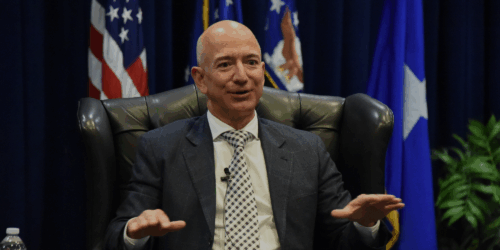
Dear Jeff Bezos,
Like most people in America and around the world, we know who you are. You are the founder and executive chairman of Amazon. You’re the owner of The Washington Post, the founder of space technology company Blue Origin, and the recent co-founder and co-CEO of artificial intelligence company Project Prometheus. As of this writing, you’re also the fourth richest person in the world, with a fortune of a cool $273 billion.
The Patriotic Millionaires aren’t as high up the Forbes list as you are, but we’re rich too. If you’re not familiar with us, we’re a group of 200 affluent Americans using our influence and unique voices to create an economy that works for everyone, not just wealthy people like us. We come from all over the country and work in a variety of professional industries; some of us are business owners and executives like you, but we also count investors, lawyers, inheritors, filmmakers, authors, and more among our ranks. We also have sister chapters in the United Kingdom and Canada.
We saw the interview that you gave last week to Andrew Ross Sorkin on CNBC’s “Squawk Box,” and wanted to respond to some of the things you said that relate to our three-pronged mission to tax the rich, pay the people, and spread the power. There are places we agree, and areas we do not. We hope that you will approach this letter with an open mind, and consider joining us in our work.
During your interview, you were fixated on the economic life of a nurse in Queens. You said:
“A nurse in Queens who makes $75,000 a year pays 12 – more than $12,000 a year in taxes. Does that really make sense? So, people talk about making the tax system more progressive. How about we start by having the nurse in Queens not pay taxes? …we shouldn’t be asking this nurse in Queens to send money to Washington. They should be sending her an apology. It really makes no sense.”
We were thrilled to hear you say you support things like New York’s new pied-à-terre tax, closing “crony capitalism” corporate tax loopholes, and fixing the “buy, borrow, die” loophole. But your support for eliminating the income tax liability of Americans struggling to afford basic essentials was what really caught our attention.
We’re glad to hear that you plan to advocate for such a policy with President Trump. Fortunately, we’ve already done most of the heavy lifting for you. In March, we joined Senator Chris Van Hollen (MD), Senator Mark Kelly (AZ), and Representative Don Beyer (VA-08), and a number of their congressional colleagues to help introduce the Working Americans’ Tax Cut Act, or “WATCA” for short. This legislation would provide a “Cost of Living Exemption” on federal income taxes up to the cost of living for a single adult with no children (approximately $46,000), and it will transfer the responsibility for the lost revenue to the millionaire class by establishing a graduated surtax on incomes over $1 million. This legislation was modeled after the second part of our very own legislative platform, The MONEY Agenda, and we were ecstatic to see it come to life after many months of behind-the-scenes work.
Over the last few months, we’ve caught quite a bit of flack over WATCA, even from people that we work closely with. One of the most common criticisms we’ve received is that it’s only fair that everyone has “skin in the game” when it comes to paying federal taxes, but we don’t see it that way. Aside from the fact that Americans already have “skin in the game” in paying a host of federal taxes besides income taxes (e.g. payroll taxes, excise taxes, tariffs, etc.), we don’t think it’s right that people should be pushed into, or further into, poverty by their federal income tax bills. If we can help an estimated 130 million Americans better afford things like rent, groceries, and gas by removing their federal income tax liability, then doing so should be a no-brainer.
Needless to say then, it was refreshing to hear someone with a profile as big as yours openly support our policy on a national stage. If you’d like to join us in our continued efforts to push lawmakers to make WATCA a reality, we’d love to have you.
“These people sometimes say that, that, you know, I don’t pay taxes. That’s not true. I pay billions of dollars in taxes. And it’s…again, if people want me to pay more billions, then let’s have that debate. But don’t pretend you know that this, that that’s going to solve the problem. You could, you could double the taxes I pay and it’s not going to help that teacher in Queens, I promise you.”
And here’s where you lost us. If we understand you correctly, you are not completely on board with WATCA’s graduated income surtax on millionaires, or with raising taxes on billionaires like yourself in other ways. But as we see it, taxing the rich is a central piece of addressing and solving distressing levels of economic inequality.
Before you made the above comment, you said that the United States already has a progressive tax system, and that “the top 1 percent of taxpayers pay 40 percent of all the tax revenue.” That’s an oft-cited statistic we encounter, and it’s correct with regard to federal income taxes. But as a percentage of their income—and more specifically, their true economic income, including their unrealized capital gains—wealthy people like you and us are actually paying lower tax rates than working people. So we can’t honestly say our income tax is progressive.
We imagine you saw the bombshell 2021 ProPublica report that told the world you paid a true tax rate of just 0.98% on over $99 billion in gains between 2014 and 2018. Do you really think that’s progressive? We’ll also flag that income taxes are just one of many taxes in our tax code. And when you look at them all together, the 400 wealthiest Americans actually pay a lower total tax rate than the average American.
One reason that we want to pay more in taxes is to fix this gross inequity. But there’s another reason, which brings us to our next point.
You said that, even if you paid double the taxes you pay now, that would not help a teacher in Queens. We disagree. Making our tax code fairer is something that would help everyone as a matter of principle.
But there are more practical reasons too. If you’re made to pay higher taxes in New York, that could raise money that officials could use to enhance a variety of services, like libraries, museums, hospitals, subways, schools, and more. That would all definitely help a teacher in Queens.
Later in the interview, you seemed to imply with your comments about NYC schools that, if you were taxed more, you worry that the extra revenue raised from your taxes would be squandered and wasted. If we’re understanding you correctly, you’re suggesting that you would be happy to pay more in taxes, so long as you knew your tax dollars were being directed to programs and areas which you approved. This is something that we hear a lot, and it’s an understandable view. But unfortunately, that’s not how government works. If you don’t like the way politicians are spending, you have the option to vote them out of office like everyone else does on Election Day. It is not an excuse for you to avoid paying your rightful share in taxes, especially over someone struggling to make ends meet like a teacher in Queens. That’s why we here at Patriotic Millionaires don’t take official positions on how electeds spend revenue, only on how they raise it.
You also later suggested that billionaires like yourself are not driving the affordability crisis. Given what we’ve seen from billionaires in the private equity industry, we disagree. There’s evidence that billionaire-run private equity firms have increased the cost of housing, healthcare, childcare, groceries, youth sports, pet care, and more. We should take measures to rein in private equity’s practices, but it would also be worthwhile to tax billionaires more and redistribute the trillions they’ve received over the years from working people’s pockets. That would definitely help a teacher in Queens.
On a macro level, billionaires like you being taxed more would ensure that they do not have as much power over a Queens teacher’s life that, whether you realize it or not, they currently do. In your case, you wouldn’t have the means to buy an entire newspaper (à la The Washington Post) and control what news she sees. As for the rest of the billionaire class, it would ensure they don’t have the means to wreck the environment, buy up entire social media platforms, treat small towns like their own personal playgrounds, and dominate our elections. That would also definitely help a teacher in Queens. We promise you.
“Let’s say you start a burger joint, and you have ten employees and you make a little bit of money…And so then you open a second outlet. And now you’re making a little bit more money and you have 20 employees and you open a third outlet. By the time you’ve opened 1,000 outlets, you are a billionaire…At what point did that money all of a sudden become unethical?”
This is the burger analogy that you gave in response to Andrew’s question about Rep. Alexandria Ocasio-Cortez’s recent comments about billionaires not being able to earn their fortunes without doing things like obtaining market power, breaking rules, abusing labor laws, and underpaying people. Your analogy was helpful, but we feel it’s disingenuous for you to use it to suggest you made your fortune completely ethically.
You boasted about the $23 entry level wage that you offer Amazon workers in Queens. That might make for a decent living in some other parts of the country, but not in Queens. According to the MIT Living Wage Calculator, a single adult with no children in Queens needs to make at least $35 an hour to afford essentials; meanwhile, a single adult with just one child needs to make at least $57. It’s also worth noting that reports have found that thousands of Amazon employees rely on government programs like SNAP and Medicaid just to get by. The math is clear you are underpaying your workers, and that plays a part in making you so rich.
We also feel it’s worth mentioning that Amazon was sued by the Biden administration in 2023 over accusations of illegal monopolistic practices. And that Amazon was sued by delivery drivers the same year for being forced to pee in bottles to meet the company’s outlandish quotas. And that Amazon spends millions each year on its notorious union-busting campaign. And that Amazon was just forced by NYC Mayor Mamdani to pay over $9 million in idling fines. And that Amazon was recently found to be violating disabled workers’ rights. Which are all, in our books, pretty unethical.
Several times in your interview, you voiced your frustration with people and politicians villainizing billionaires. To be clear, we try not to make it our business to shame any one particular billionaire or wealthy person—that is, unless they do something unethical or shameful to achieve their wealth.
Rather, what we are villainizing is the various systems that allow people to become as wealthy and powerful as you while millions of families around the county suffer. When we hear chants of “Tax the rich!,” we don’t get offended. We know people are not angry at us personally—and if they are, we’re sure we’ll hear about it. Instead, they are angry at the “tale of two economies,” as you call it. You correctly said in the interview there is not a fixed amount of wealth that anyone could hoard. But you are incorrect in using that comment to imply that people don’t have a right to be angry. They are working harder than ever—literally, research shows that they are more productive than ever before—but their paychecks aren’t rising accordingly. The tide is rising thanks to them, but it’s only lifting rich people’s yachts higher and higher. And they have every right to be angry because of it.
You said that pointing fingers and picking villains doesn’t solve anything. We disagree. An important step in fixing a problem is to correctly ascertain what that problem actually is, and who is at fault for it. Lucky for you, we’ve done that: The biggest problem in America is massive inequality. Rich people like us are to blame for it, in various ways. And we already know how to solve it: tax us more.
Conclusion
Towards the end of the interview, you said that you are “on the side of America…and that’s where business leaders should be.” It was a profound and beautiful thing to say.
We believe that your heart is in the right place about supporting eliminating the income tax liability of people struggling to make ends meet. But to well and truly get “on the side of America,” as you say, you have more to do. And we’re here to help you do it.
We encourage you to recognize that you, along with us and the rest of America’s ultra-wealthy, are responsible for the problem of inequality in this country as we described above. If you want to be part of the solution, we welcome you to join us in our mission to tax the rich, pay the people, and spread the power.
Warmly,
The Patriotic Millionaires