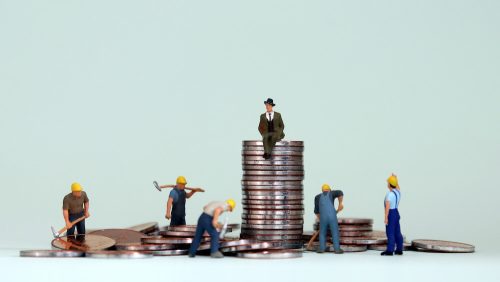
It’s a tale as old as time: if you give the wealthy and corporations special tax breaks, they will invest their savings into the broader economy, which ultimately creates jobs and benefits everyone in the long run.
If only it was remotely true.
America has pursued “trickle-down” economic policies long enough for us to know that they do not work, full stop. Lawmakers have heaped mountains upon mountains of tax cuts on the wealthy and corporations over the years, and what’s happened? They pooled at the top, and barely trickled down to America’s valley of working people.
Unfortunately, politicians of both parties have propped up the fallacy of trickle-down economics. Just last week, President Trump and Republicans officially passed their One Big Beautiful Bill Act. They claim the legislation is the most “pro-worker” in American history, but analysis after analysis has found that the biggest benefits of the bill will ultimately flow to top earners. On the other hand, we’ve seen how Democrats are comfortable supporting trickle-down economics, without ever actually saying the words. During her 2024 presidential campaign, former Vice President Kamala Harris made headlines on the campaign trail for publicly supporting a lower tax rate for wealthy investors because, in her words, “it leads to broad-based economic growth and it creates jobs.” It’s trickle-down economics, just with different branding.
For this week’s Closer Look, we want to squash the idea, once and for all, that corporations and wealthy people like us need tax breaks to create jobs and grow the economy. We’ll start with corporations and expose what they actually do with their mega tax breaks. Then we’ll move onto wealthy investors, with special attention to the job destruction wrought by private equity managers. Finally, we’ll close by telling you who the real job creators are in America.
Spoiler alert: it’s working people.
Corporations aren’t job creators
The One Big Beautiful Bill Act’s predecessor, the 2017 Tax Cuts and Jobs Act (TCJA), did wonders for corporations’ tax bills. Among other things, it slashed the corporate income tax rate from 35% to 21%, and allowed companies to deduct expenses for research and development, interest payments, and asset depreciation.
Proponents of the TCJA said that companies would use the savings they received through these tax breaks to invest in their productive capabilities. In other words, they would buy new capital like machinery, equipment, trucks, facilities, and other technologies that would help them make new products or improve existing ones, which would ultimately grow their profit margins, create jobs, and benefit the whole economy.
But that’s not what happened.
A study by the International Monetary Fund found that in 2018, large firms spent only 19% of the savings they received through the TCJA on research and development and capital investments. The remaining 81% went to enriching shareholders through enhanced share buybacks and dividend payments. In the years following the TCJA’s passage, GDP growth did not accelerate either, and consumer spending, business investment, and housing investment actually slowed.
On the 2024 campaign trail, President Trump said that he wanted to further reduce the corporate tax rate from 21% to 15%. Fortunately, the One Big Beautiful Bill did not do this, but it did permanently reinstate the aforementioned deductions for research and development, interest payments, and asset depreciation. Some are even retroactive—which is a bit weird to us, because it obviously is not possible for a change in the law now to incentivize something that already happened last year. We’ll have to wait a while to see its effects on job creation and economic growth, but we’re not going to hold our breath. The Yale Budget Lab already found that, by 2054, GDP will be 3% smaller than what it would be had the bill not passed.
The bottom line: no, corporations do not create jobs when they get special tax breaks. They just pass the savings on to their top brass.
Rich people aren’t job creators
Many of our members at Patriotic Millionaires are investors. It’s common for us to hear that investors like us need lower tax rates on our investment income as incentives to invest, create jobs, and grow the economy. That’s total nonsense, and we’ll explain why.
If you have $1 million and you’re deciding what to do with it, you have two broad options:
- Keep the $1 million under your mattress in cash. At the end of the year, you’d pay no taxes and have kept your $1 million.
- Invest the $1 million and make more money. Even if the top marginal tax rate on capital gains rose to 99%, you’d still have more than what you started with.
If you’re business-minded like us, the obvious choice is #2. Research also backs this up, as it has shown that changes in capital gains tax rates have no significant effect on private savings behavior or economic growth. A 2024 study from American University that analyzed former President Biden’s proposal to raise the top capital gains rate to 39.6% (to equal that of labor income) found that it would actually increase economic growth, in addition to lowering income and wealth inequality.
People tend to use the terms “shareholder” and “investor” interchangeably, but the truth is that shareholders are not always investors in their companies. If you buy stock in a large company like Apple, you are not giving Apple funds to create new products or improve the functionality of their existing ones, like iPhones and MacBooks. Apple shares are sold on secondary markets, so when you buy stock in Apple, you are giving money to the person or institution from which you bought the shares. Apple’s share price might rise as a result, but they’re not giving money to the company to fund investment. This is the case with most companies most of the time, which primarily finance their investments with internal funds.
In short, if the money that we use to buy stock in companies like Apple isn’t actually being used to create new products that then create jobs, we cannot honestly call ourselves job creators. And sitting at our computers all day and watching the price of our stocks tick up and down isn’t going to do the trick to create more jobs either.
To be sure, some rich people have a little bit more of a claim to the “job creator” title than others. For example, if someone is an entrepreneur who built their business from the ground up or was one of the original Apple investors during its IPO in 1980—where Apple raised $100 million to fund its operations—no one can deny that their work helped to create jobs. But we still hesitate to call them the real job creators in America. (If you’re confused as to why we’re still hesitant, hang tight—we’ll tell all in the next section.)
Finally, it is worth noting that there are some in the investor class—namely, private equity managers—who are job destroyers. Private equity firms buy companies and assets with the sole purpose of increasing their value/maximizing capital gains over a limited period. In other words, they are not investing to improve the productive capabilities of companies in the long term, but merely extracting value to improve the financial returns of the firm and its managers in the short term. It’s worth noting that companies acquired by private equity firms tend to have higher employee turnover and post lower salaries than competitors. The sad case of Toys ‘R’ Us provides a good example of the harms that private equity can wreak on companies.
The real job creators are working people
So if corporations and rich people aren’t the job creators in America, who are?
The answer was, is, and always will be: consumers who cash paychecks and spend money.
The reason why working people in America are the job creators has to do with how our economy operates. Consumer spending accounts for 70% of GDP in America. The health and growth of our economy primarily relies on people buying things like lawn mowers, movie tickets, ice cream, blue jeans, and lamps.
We rich people have a lot of money to spend, but the sad truth is that most of us couldn’t spend down our fortunes even if we tried. We’re not some special class of humans, and there are only so many of us. We can only buy so many lawn mowers, so many movie tickets, so many ice creams, etc.—and we only have so many friends and family to buy them for too.
But for the millions of people who work for a living around the country, it’s a very different story. When they have extra money in their pockets and a bit more disposable income, they are more likely to spend it on goods and services outside their normal budgets. But when too many people are too busy just trying to cover the bare essentials and living paycheck to paycheck, our economy comes to a screeching halt.
In the end then, it’s the millions of working people around the country that keep our economy humming and create jobs by buying goods and services. We don’t live in a “trickle-down” economy but rather a “trickle-up” one, where benefits flow up and out from the economic activities of millions on Main Streets around the country.
As we said, there are a small handful of people in our class, namely venture capital investors and entrepreneurs, who can safely be called job creators. For example, our Vice-Chair, Stephen Prince, founded Card Market, Inc. as a gift card production company in the 1990s and employed hundreds of people over the years. We’re not denying that, and we’re glad that people like Stephen have the gumption to bring their good business ideas to life.
But here’s the thing. In our consumer-demand economy, a good idea is only a good idea because other people think so and say as much with their dollars. We can only say that Stephen’s gift card production company was a good idea because thousands of customers said so over the years by deciding to buy his product. We only know that iPhones, chocolate chip cookies, hula hoops, and water beds are good ideas because, again, millions of people have said so over the years with their dollars. You may think you have a good idea for a product or business in America, and that’s great, but the reality is that in order to be a success and create jobs, other people have to think so too. Which, in the end, makes them the real job creators.
Conclusion
If our elected officials want to reform our tax code and want to give tax breaks to some people in America to create jobs and grow the economy, they can. But it’s best that they give them to the right people—namely, working people who are America’s real job creators, not millionaires like us. Research has found that job growth stemming from tax cuts is largely driven by tax cuts targeted at the bottom 90% of earners.
This is also why we want lawmakers to enact our “Cost of Living” Tax Cut Act so badly. (If you’re unfamiliar with this proposal, along with the rest of our legislative platform, The MONEY Agenda: America 250, we’ve got you covered.) We don’t want to tax working people into poverty, and we also want to do what’s best for the economy. They are not mutually exclusive ideas. If our “Cost of Living” Tax Cut proposal was implemented, millions of people would undoubtedly use their substantial savings to spend more widely in their local economies, which would create jobs.
Our message to lawmakers is simple: stop telling tales about “trickle-down” economics that have been debunked over and over and over again. Stop calling rich people job creators. And finally, start telling the truth about who the real job creators are in America and tax them accordingly with our “Cost of Living” Tax Cut Act.